'%3e%3cg id='Final-Copy-2_2_' transform='translate(1275.000000, 200.000000)'%3e%3cpath class='st0' d='M7.4,12.8h6.8l3.1-11.6H7.4C4.2,1.2,1.6,3.8,1.6,7S4.2,12.8,7.4,12.8z'/%3e%3c/g%3e%3c/g%3e%3c/g%3e%3cg id='final---dec.11-2020'%3e%3cg id='_x30_208-our-toggle' transform='translate(-1275.000000, -200.000000)'%3e%3cg id='Final-Copy-2' transform='translate(1275.000000, 200.000000)'%3e%3cpath class='st1' d='M22.6,0H7.4c-3.9,0-7,3.1-7,7s3.1,7,7,7h15.2c3.9,0,7-3.1,7-7S26.4,0,22.6,0z M1.6,7c0-3.2,2.6-5.8,5.8-5.8 h9.9l-3.1,11.6H7.4C4.2,12.8,1.6,10.2,1.6,7z'/%3e%3cpath id='x' class='st2' d='M24.6,4c0.2,0.2,0.2,0.6,0,0.8l0,0L22.5,7l2.2,2.2c0.2,0.2,0.2,0.6,0,0.8c-0.2,0.2-0.6,0.2-0.8,0 l0,0l-2.2-2.2L19.5,10c-0.2,0.2-0.6,0.2-0.8,0c-0.2-0.2-0.2-0.6,0-0.8l0,0L20.8,7l-2.2-2.2c-0.2-0.2-0.2-0.6,0-0.8 c0.2-0.2,0.6-0.2,0.8,0l0,0l2.2,2.2L23.8,4C24,3.8,24.4,3.8,24.6,4z'/%3e%3cpath id='y' class='st3' d='M12.7,4.1c0.2,0.2,0.3,0.6,0.1,0.8l0,0L8.6,9.8C8.5,9.9,8.4,10,8.3,10c-0.2,0.1-0.5,0.1-0.7-0.1l0,0 L5.4,7.7c-0.2-0.2-0.2-0.6,0-0.8c0.2-0.2,0.6-0.2,0.8,0l0,0L8,8.6l3.8-4.5C12,3.9,12.4,3.9,12.7,4.1z'/%3e%3c/g%3e%3c/g%3e%3c/g%3e%3c/g%3e%3c/svg%3e) Your Privacy Choices
Your Privacy Choices
 Financial Services
 Healthcare
 Insurance
 Retail
 Travel & Entertainment
 Utilities & Home Services
 Automotive
 Technology
 Call Centers
 INFORM
 AFFIRM
 SENTRY
 PROTECT+
 Carrier Solutions
 Developers
 North America Customer Login
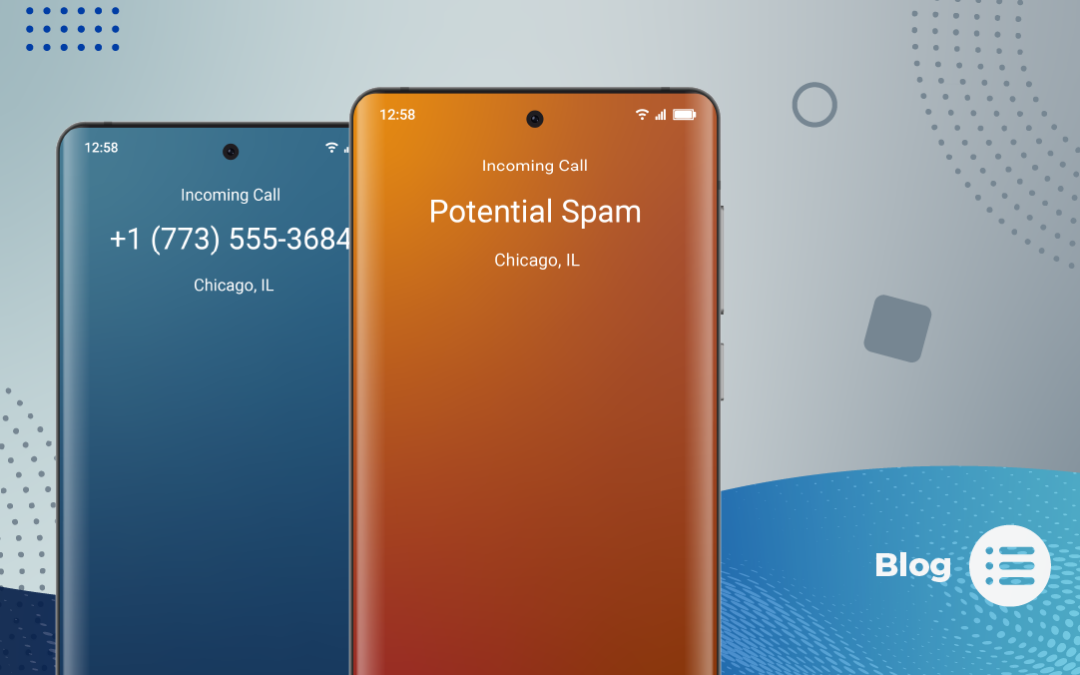
To protect subscribers, phone carriers employ Analytics Engines (AEs), complex AI models that assign a “reputation score” to every single phone number on the network.
When a business call is placed, these engines evaluate it in milliseconds based on several factors:
- Attestation Levels: If your call isn’t properly “signed” with a high level of attestation (specifically Level A), the network treats it with immediate suspicion. It’s the digital equivalent of showing up at a border crossing without a passport.
- Crowdsourced Reports: If even a small handful of consumers manually block your number or report it via “Report Spam” buttons on their iPhones or Androids, the analytics engines take notice. Once you cross a certain threshold, a “Scam Likely” label is automatically applied.
- Call Duration Patterns: If your outbound calls consistently last less than 15 seconds, the system flags you. Why? Because legitimate conversations usually last longer, while robocalls and scams are typically short or result in immediate hang-ups.
Why are Calls Mislabeled?
Carriers use sophisticated algorithms to protect consumers from the billions of robocalls made every year. While these systems are well-intentioned, they aren’t perfect. Your number might be flagged due to:
| Risk Factor | How Carrier Algorithms Interpret It |
| High Call Volume | Making a large number of outbound calls in a short time window mimics “robocall” or automated dialing patterns. |
| Short Call Duration | Frequent hang-ups within seconds suggest the call was unwanted, unsolicited, or a potential scam. |
| Inconsistent Dialing Patterns | Sudden spikes in activity from a previously dormant number look like a “spoofing” or high-frequency blast attack. |
| Legacy Data | You may have inherited a “dirty” number with a pre-existing negative reputation from a previous owner. |
How to Fix and Prevent Mislabeling
Fixing your number’s reputation isn’t a one-and-done task; it requires a proactive approach to reputation management. You can prove your identity to the carriers or remediation through the following ways.
Register Your Numbers
Don’t be a stranger to the carriers. You should register your outbound numbers with the major wireless providers and third-party analytics engines. This establishes you as a “vetted” caller.
You can register your numbers for free with First Orion. The process takes five minutes or less, and First Orion walks you through each step. In most cases, confirmation is received within minutes.
Implement AFFIRM™ Number Monitoring
While labels occurs at the analytics engine and carrier levels, First Orion has solutions to help businesses influence their call labels and monitor for spam and scam tags associated with their business numbers.
AFFIRM Number Monitoring businesses monitor spam/scam activity of their business phone numbers on calls across all 3 major U.S. carriers. The business is alerted anytime calls are tagged as spam and scam through First Orion’s easy-to-use customer portal.
AFFIRM Case Study: Pacific Debt Relief, a leader in the debt settlement industry, faced a major challenge: legitimate calls to clients were being tagged as “Spam” or “Scam,” causing engagement to plummet. Their technical team was forced to manually validate numbers using multiple mobile devices, an exhausting and expensive process.
By implementing AFFIRM, Pacific Debt Relief achieved transformative results:
| Performance Metric | Achievement & Business Impact |
| Call Success Rate | 20–30% increase in successful connections. |
| Monthly Revenue | $700,000 increase in additional monthly enrollments. |
| Operational Efficiency | 617 person-hours saved per month (approx. 4 full-time employees). |
| Number Reputation | Reduced spam/scam tags across all carriers to zero. |
Practice Good Dialing Hygiene
Call behavior best practices provide businesses with insights into industry standards for good calling practices. Registering business numbers and exercising good calling practices are the best ways to mitigate tagging.
Avoid “spray and pray” tactics. Ensure your lists are scrubbed against the Do Not Call (DNC) registry and that you are calling people who want to hear from you. Here are tips:
| Strategy Category | Recommended Best Practice |
| Number Strategy | Do not use a single main telephone number for multiple, unrelated purposes. |
| Number Strategy | Provide a consistent, real, and user-dialable callback number with every call. |
| Call Frequency | Avoid excessive or repetitive calling to the same recipient. |
| Call Frequency | Do not frequently dial unassigned or disconnected phone numbers. |
| Consent & Compliance | Ensure users are expecting your call and respect all “do not contact” requests. |
| Consent & Compliance | Do not use pre-recorded messages for lead prospecting or cold outreach. |
| Branding & Context | Provide a consistent Calling Name (CNAM) that matches the context of the call. |
| Branding & Context | Align the context and content of your calls for the duration of the number’s assignment. |
| Monitoring | Document and maintain “normal” calling patterns to avoid triggering AI anomalies. |
Get Started
Ready to fix your business’s calling reputation? Don’t let “Scam Likely” labels undermine your team’s hard work. Start protecting your outbound numbers today with AFFIRM Number Monitoring.