'%3e%3cg id='Final-Copy-2_2_' transform='translate(1275.000000, 200.000000)'%3e%3cpath class='st0' d='M7.4,12.8h6.8l3.1-11.6H7.4C4.2,1.2,1.6,3.8,1.6,7S4.2,12.8,7.4,12.8z'/%3e%3c/g%3e%3c/g%3e%3c/g%3e%3cg id='final---dec.11-2020'%3e%3cg id='_x30_208-our-toggle' transform='translate(-1275.000000, -200.000000)'%3e%3cg id='Final-Copy-2' transform='translate(1275.000000, 200.000000)'%3e%3cpath class='st1' d='M22.6,0H7.4c-3.9,0-7,3.1-7,7s3.1,7,7,7h15.2c3.9,0,7-3.1,7-7S26.4,0,22.6,0z M1.6,7c0-3.2,2.6-5.8,5.8-5.8 h9.9l-3.1,11.6H7.4C4.2,12.8,1.6,10.2,1.6,7z'/%3e%3cpath id='x' class='st2' d='M24.6,4c0.2,0.2,0.2,0.6,0,0.8l0,0L22.5,7l2.2,2.2c0.2,0.2,0.2,0.6,0,0.8c-0.2,0.2-0.6,0.2-0.8,0 l0,0l-2.2-2.2L19.5,10c-0.2,0.2-0.6,0.2-0.8,0c-0.2-0.2-0.2-0.6,0-0.8l0,0L20.8,7l-2.2-2.2c-0.2-0.2-0.2-0.6,0-0.8 c0.2-0.2,0.6-0.2,0.8,0l0,0l2.2,2.2L23.8,4C24,3.8,24.4,3.8,24.6,4z'/%3e%3cpath id='y' class='st3' d='M12.7,4.1c0.2,0.2,0.3,0.6,0.1,0.8l0,0L8.6,9.8C8.5,9.9,8.4,10,8.3,10c-0.2,0.1-0.5,0.1-0.7-0.1l0,0 L5.4,7.7c-0.2-0.2-0.2-0.6,0-0.8c0.2-0.2,0.6-0.2,0.8,0l0,0L8,8.6l3.8-4.5C12,3.9,12.4,3.9,12.7,4.1z'/%3e%3c/g%3e%3c/g%3e%3c/g%3e%3c/g%3e%3c/svg%3e) Your Privacy Choices
Your Privacy Choices
 Financial Services
 Healthcare
 Insurance
 Retail
 Travel & Entertainment
 Utilities & Home Services
 Automotive
 Technology
 Call Centers
 INFORM
 AFFIRM
 SENTRY
 PROTECT+
 Carrier Solutions
 Developers
 North America Customer Login
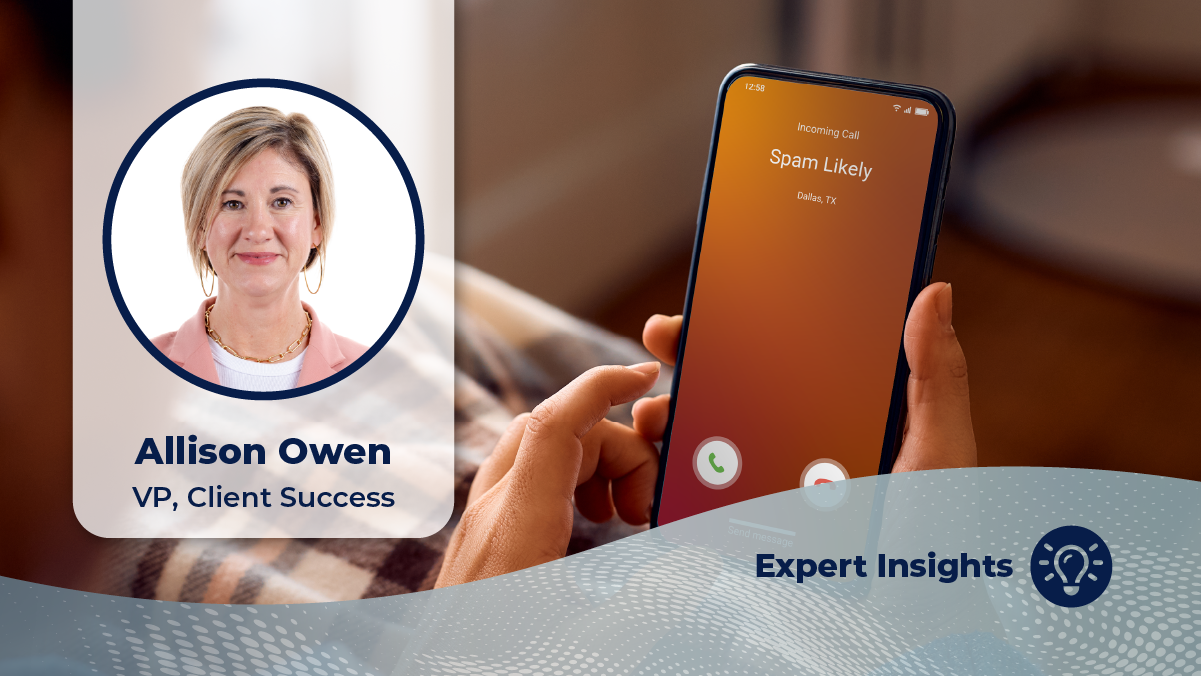
By Allison Owen
VP of Client Engagement
Spam tagging is one of the most frustrating challenges legitimate businesses face when trying to connect with their customers. While consumers demand and deserve protection from unwanted calls, many lawful, necessary calls still get flagged as “Spam” by carriers and third-party analytics.
The standard industry response is a cycle of paying third parties to appeal and “remove” these tags manually. However, this only delivers a short-lived lift that evaporates the moment a number’s calling behavior trips the models again. This article explains the current state of call labeling, separates spam from scam, quantifies the impact on businesses, and provides a prescriptive plan that prioritizes fixing behavior over buying band-aids.
In short: build lasting trust with identity, authentication, and respectful dialing, not with temporary appeals.
Scam vs. Spam: Clear Lines Matter
Lumping spam and scam together erodes trust. Consumers become less willing to answer any unknown number even when it is their bank, healthcare clinic, or delivery service. It is important to know the differences.
Scam Calls
Scam calls are defined as fraudulent calls where the caller attempts to defraud victims from personal information or money.
Recent data from the FTC shows the staggering scale of the problem: reported consumer fraud losses hit $12.5 billion in 2024, with a median loss of $1,500 per person1. Preventing these large-scale criminal losses requires structural solutions, not cosmetic remediation.
Spam Calls
In contrast, a spam call is not necessarily a criminal scam attempt. Many of these originate from legitimate businesses that use unfair or poor calling practices, which leads to annoyed customers.
Examples range from political or polling calls to charities that repeatedly call numbers to gather donations. While legitimate, these practices create a negative user experience and trigger consumer complaints, resulting in spam tags. Most negative tags are driven by these nuisance patterns, which is far more than by outright fraud.
The Permanent Fix Requires More Than an Appeal
For Consumers: Manual appeals that temporarily lift labels don’t change the experience if the outreach still feels spammy. Consumers already distrust unknown calls. Data from First Orion shows that 87% of mobile users don’t answer calls from unknown numbers, and over 40% said they chose not to answer because their phone didn’t identify the call properly, so, trust doesn’t return because a tag disappeared for a while.
For Businesses: Paying recurring fees to “fix” numbers is costly and unsustainable. If your patterns (e.g., excessive attempts, short calls, irrelevant scripts) remain, the tag returns. That’s money burned without durable improvement in contact or conversion. Identity, authentication, and respectful cadence—not appeals—are the reliable path to performance.
It is worth noting that businesses taking proactive steps to establish trust see significant performance benefits. For example, when brands use Branded Calling to display their name, answer rates improve by up to 50% compared to unbranded calls, according to First Orion data. This demonstrates that giving consumers a clear identity and context is the first, most effective step toward rebuilding trust in the voice channel.
For Carriers & the Ecosystem: Allowing outcomes to be influenced by appeals undermines analytics and consumer trust. Regulators continue tightening the screws on unlawful traffic (e.g., caller ID authentication mandates, non-IP proposals), and a shadow market of tag “removal” is at odds with that policy direction.
What Actually Works
1. Register & Authenticate
- Number Registration: Ensure every outbound number is registered with major analytics ecosystems and carrier partners. This practice validates number ownership with a verified business. This is the first step in good behavior, but it doesn’t prevent spam tagging.
- Call Authentication: Authentication matters and raises the baseline for caller identity by helping carriers differentiate legitimate calls from spoof calls. Spoof calls damage your brand reputation and can trigger analytics to issue spam tags. Treat authentication as necessary complements to number reputation management, registration, branding, and monitoring.
2. Brand the Call for Identity and Context
Displaying your name, logo, and the reason for the call allows the recipient to make an informed decision about answering. Branded identity materially improves answer and engagement rates. For instance, the data mentioned earlier—that answer rates can improve by up to 50%—highlights the value of providing clear context.
However, it is vital to understand that branding your calls does not, in and of itself, prevent spam tagging. Carriers and analytics engines work to protect consumers from scam and nuisance calls, a determination that is applied down the line from Branded Calling. The spam models care about call behavior and complaint data, not whether you are using a branded solution.
3. Monitor Reputation & Outcomes (Not Just Labels)
You cannot fix what you cannot see. Businesses must monitor key signals across every number and campaign:
- Watch Outcomes: Track answer, contact, block/decline, call duration, and customer complaint signals.
- Identify Patterns: Look for specific patterns that commonly trigger nuisance labeling, such as bursting call attempts, repeat dials across short windows, and an excessive rate of very short call durations (e.g., failed connections or quick hang-ups). These are the red flags for analytics models.
4. Optimize Cadence, Targeting & Content
Revising calling strategy is the most effective form of spam call remediation:
- Cadence: Cap call attempts per day or week, use thoughtful spacing between dials, and strictly avoid “redial storms.”
- Targeting: Rather than calling everyone, prioritize high-probability contacts and ensure the reason for calling is immediately relevant to that customer.
- Content: Lead with who you are and why you’re calling in the very first sentence of the script. If a call reason is displayed on the screen, ensure the script aligns perfectly with that context.
5. Give Consumers Control
Respecting consumer preferences is a direct way to reduce complaints and maintain trust:
- Offer self-service preferences for call windows, preferred contact channels, and opt-down options.
- Follow up with contextual SMS or email when appropriate and compliant.
- Make it easy for customers to verify your identity (e.g., a known short code, a callback number printed on account statements or portals).
Conclusion
You don’t rebuild trust with appeals; you rebuild it with identity, authentication, and behavior. If your outreach still looks and feels like spam, a temporary label change won’t save performance. Fix the root causes, brand your calls, authenticate, and respect the consumer’s time. That’s how we protect consumers, help legitimate businesses connect, and give scammers the boot.
About Allison Owen
Allison Owen is the Vice President of Client Engagement at First Orion, where she oversees the client and partner experience. She has over 25 years of CX experience, which includes leadership roles at industry-leading data marketing companies such as Merkle and Acxiom. She attended the University of Central Arkansas and earned a Bachelor of Science degree.
Sources