'%3e%3cg id='Final-Copy-2_2_' transform='translate(1275.000000, 200.000000)'%3e%3cpath class='st0' d='M7.4,12.8h6.8l3.1-11.6H7.4C4.2,1.2,1.6,3.8,1.6,7S4.2,12.8,7.4,12.8z'/%3e%3c/g%3e%3c/g%3e%3c/g%3e%3cg id='final---dec.11-2020'%3e%3cg id='_x30_208-our-toggle' transform='translate(-1275.000000, -200.000000)'%3e%3cg id='Final-Copy-2' transform='translate(1275.000000, 200.000000)'%3e%3cpath class='st1' d='M22.6,0H7.4c-3.9,0-7,3.1-7,7s3.1,7,7,7h15.2c3.9,0,7-3.1,7-7S26.4,0,22.6,0z M1.6,7c0-3.2,2.6-5.8,5.8-5.8 h9.9l-3.1,11.6H7.4C4.2,12.8,1.6,10.2,1.6,7z'/%3e%3cpath id='x' class='st2' d='M24.6,4c0.2,0.2,0.2,0.6,0,0.8l0,0L22.5,7l2.2,2.2c0.2,0.2,0.2,0.6,0,0.8c-0.2,0.2-0.6,0.2-0.8,0 l0,0l-2.2-2.2L19.5,10c-0.2,0.2-0.6,0.2-0.8,0c-0.2-0.2-0.2-0.6,0-0.8l0,0L20.8,7l-2.2-2.2c-0.2-0.2-0.2-0.6,0-0.8 c0.2-0.2,0.6-0.2,0.8,0l0,0l2.2,2.2L23.8,4C24,3.8,24.4,3.8,24.6,4z'/%3e%3cpath id='y' class='st3' d='M12.7,4.1c0.2,0.2,0.3,0.6,0.1,0.8l0,0L8.6,9.8C8.5,9.9,8.4,10,8.3,10c-0.2,0.1-0.5,0.1-0.7-0.1l0,0 L5.4,7.7c-0.2-0.2-0.2-0.6,0-0.8c0.2-0.2,0.6-0.2,0.8,0l0,0L8,8.6l3.8-4.5C12,3.9,12.4,3.9,12.7,4.1z'/%3e%3c/g%3e%3c/g%3e%3c/g%3e%3c/g%3e%3c/svg%3e) Your Privacy Choices
Your Privacy Choices
 Financial Services
 Healthcare
 Insurance
 Retail
 Travel & Entertainment
 Utilities & Home Services
 Automotive
 Technology
 Call Centers
 INFORM
 AFFIRM
 SENTRY
 PROTECT+
 Carrier Solutions
 Developers
 North America Customer Login
By Mark Himelfarb
Chief Technology Officer and Ukraine Managing Director
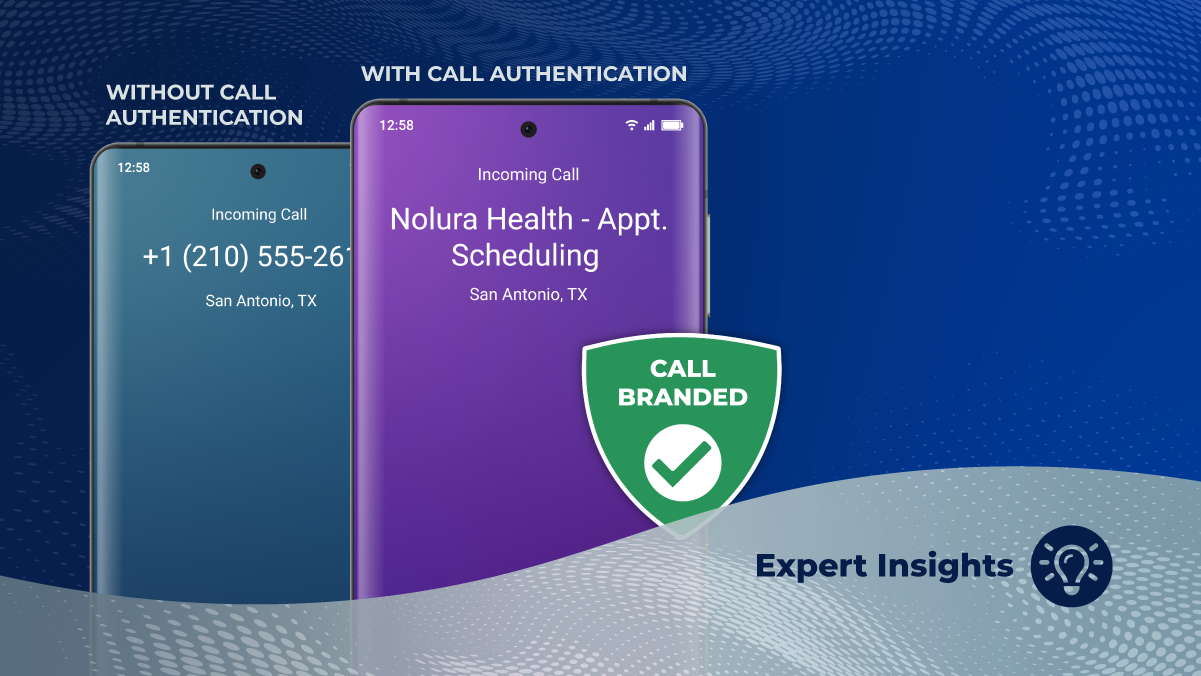
AI-driven voice impersonation has turned phone fraud into a scalable threat, eroding customer trust in brands and enterprise revenues. Legacy defenses like STIR/SHAKEN validate signaling but fail to confirm who is calling and why. Universal call authentication closes this gap by combining enterprise vetting, cryptographic attestation, authenticated display, and continuous number reputation management across every program and every major carrier.
To maintain a competitive edge in this new era of communication, leaders must shift their focus from mere compliance to comprehensive identity management.
AI Has Weaponized the Phone Channel
A cloned voice can now mimic your CEO, your collections agent, or your healthcare rep with chilling accuracy. Generative AI and real‑time voice synthesis have transformed phone fraud from a niche threat into a scalable business model for attackers. For enterprises that rely on outbound calls to drive revenue, deliver care, or manage risk, this is an existential trust gap.
Why Legacy Defenses Are Failing
For years, enterprises relied on incremental fixes such as Caller ID (CNAM) and even STIR/SHAKEN attestation. These tools help validate that a call originated from a legitimate network, but they don’t answer the questions that matter most to your customer:
- Who is calling? Is this really my bank or a fraudster spoofing their number?
- Why are they calling? Is this a legitimate program or a scam?
Attackers exploit the weakest link, like an unbranded call, an unmanaged number, or a regional carrier without robust controls. The result? Lower answer rates, higher complaint volumes, and rising fraud losses.
The worst part is that the enterprise may not even know that its numbers are being spoofed until it’s too late, and customers complain or even churn. The bad actors aren’t just blindly stumbling onto these opportunities, but according to a First Orion customer in the fintech sector, “These are not basic spoof attempts; they’re…targeted, and well-researched.”
Enter Universal Call Authentication
Universal call authentication isn’t just another term. It’s a holistic framework that travels with every single call, across every major carrier, every region, and every program. Think of it as a trust envelope that wraps the entire call lifecycle:
- Before the Call: Vetting & Registration
- Validate the enterprise, the number, and the program’s purpose.
- Enforce governance: approved scripts, disclosures, and compliance checks.
- Establish continuous telephone number reputation management—monitor and remediate numbers tagged as scam, spam or fraud to maintain trust over time.
2. During the Call: Attestation & Authenticated Display
- Apply cryptographic attestation to the signaling layer.
- Present a branded, verified display that persists in the call log.
3. After the Call: Telemetry & Feedback
- Capture outcomes (answer, handle, disposition) to tune fraud risk and telephone number reputation scores.
- Feed insights back into governance and risk models for continuous improvement.
This is what “universal” means: no gaps, no exceptions, no weak links for attackers to exploit.
Integration Options: REST vs. SIP
Enterprises can integrate universal call authentication in two primary ways:
- REST Pre‑Call API: Ideal for cloud dialers and CCaaS platforms; simple, flexible, and fast to deploy.
- SIP-Based Integration: Best for on‑prem or SIP‑native environments; offers deeper signaling control.
REST is more straightforward and agile, while SIP provides tighter protocol-level integration but doesn’t fit every integration scenario.
Why Enterprises Can’t Wait
AI impersonation changes the economics of fraud. Attackers can now clone voices in seconds and script convincing dialogue at scale. Every unmanaged number or unbranded call becomes an open door. The downstream impacts touch every part of the business.
When customers can’t identify who’s calling, answer rates decline, and program ROI collapses before a conversation ever begins. Mislabeling and scam reports pile on, inflicting lasting damage to the brand’s reputation that is difficult and costly to repair. And at the far end of the risk spectrum, voice-based social engineering continues to drive significant financial losses and data breaches, making an unauthenticated call environment not just an operational weakness, but a serious security vulnerability.
Universal call authentication flips the equation: authenticated calls lift answer rates, reduce complaints, and protect revenue streams.
Governance is the Hidden Hero
Technology alone won’t close the trust gap. Enterprises need governance guardrails:
- Centralized number management and program registration.
- Continuous telephone number reputation monitoring and remediation.
- Pre‑launch QA for scripts, disclosures, and branding assets.
- Ongoing compliance reviews for regulated sectors (HIPAA, GLBA, PCI).
Without governance, even the best tech stack becomes fragmented, and attackers thrive in fragmentation.
More Than Security
Universal call authentication is a security spend and a growth lever. Enterprises that deploy it see verified branding drive immediate lifts in answer rates, as customers gain the confidence to pick up knowing exactly who is calling. Operational efficiency follows, with fewer misroutes and reduced repeat calls cutting handle time across the board. At the same time, lower fraud exposure and declining complaint rates meaningfully shrink risk across the organization, while customers who trust the channel again reflect that confidence through stronger NPS scores and improved retention.
When these metrics are tied directly to revenue gained and losses avoided, universal call authentication stops being a line-item conversation and becomes a board-level priority.
Universal Call Authentication Impact
Here are some of the example KPIs we’ve observed with our customers:
- Answer Rate Lift: +15-30% vs. control.
- Complaint Reduction: -40-60% mislabeling/scam reports.
- Engagement Rate Lift: +20-55% vs. control.
- CX Metrics: Increase in NPS and CSAT and decrease in repeat contact.
- Efficiency Gains: Decrease in handle time re‑contact.
Final Thoughts
The reality is that AI has made fraud cheaper and faster than ever before, meaning every unmanaged number in your portfolio is an active liability. Universal call authentication is no longer an optional safeguard, but a growth lever that directly improves answer rates, reduces customer complaints, and protects revenue at scale.
First Orion’s platform meets organizations where they are, offering flexible integration paths through REST APIs for cloud-based environments and SIP headers for native telephony deployments. REST delivers simplicity and speed, while SIP provides the deeper protocol-level control that complex telephony infrastructures demand. But technology alone is not enough.
Sustaining trust over the long term requires disciplined governance of calling practices paired with continuous number reputation monitoring because in today’s landscape, credibility is earned call by call and lost just as quickly.
About Mark Himelfarb
As First Orion’s Chief Technology Officer, Mark is responsible for ensuring that company stays on the cutting edge of the industry by bringing to life software and solutions powering company’s product line through innovation in both methodology and technology. Backed by his 20+ years of experience in leading software engineering and systems design teams in a variety of industries, such as financial technology, benefits industry and education, Mark takes his passion for language learning, both computer and human, and pours it into pioneering novel approaches for tackling problems that First Orion’s customers face.