
How Banks, Lenders, and Financial Institutions Stop Fraudsters From Spoofing Their Phone Numbers
Fraud hotlines, main contact numbers, and payment reminder lines carry authority over accounts and funds, which makes them attractive to fraudsters. When a scammer spoofs your number, the consumer complies, and your institution absorbs the complaints, the “Scam Likely” labels, and the lost trust. SENTRY® Call Blocking authenticates your outbound calls in real time and blocks spoofed calls before they reach consumers.
In this guide, you’ll learn:
- How spoofing works in financial services fraud. Caller ID (CNAM) was designed for convenience, not verification, so fraud operations can display numbers your customers recognize and trust.
- What spoofing costs your outbound program. Lower answer rates, regulatory exposure, a heavier customer service burden, and long-term brand damage can all result from calls you never placed.
- How SENTRY protects your numbers. First Orion generates a time-limited key for each call and shares it with the carrier network. Calls with a valid key are delivered, and calls without one are blocked.
- Why legitimate calls get labeled “Scam Likely.” Spoofing-driven complaints and behavioral flags are two different problems, and each needs a different fix.
- Which operations SENTRY covers. Payment reminder and collections programs, fraud alert and account security calls, customer service, and automated notifications.
- How SENTRY works with INFORM® Branded Calling. Choose which programs get blocking, branding, or both, based on risk profile and business goals.
- Answers to common questions. Get answers on telephony changes, TCPA and FDCPA compliance, shared numbers, and spotting active spoofing.
First Orion in the News
View All First Orion News
October 13, 2026
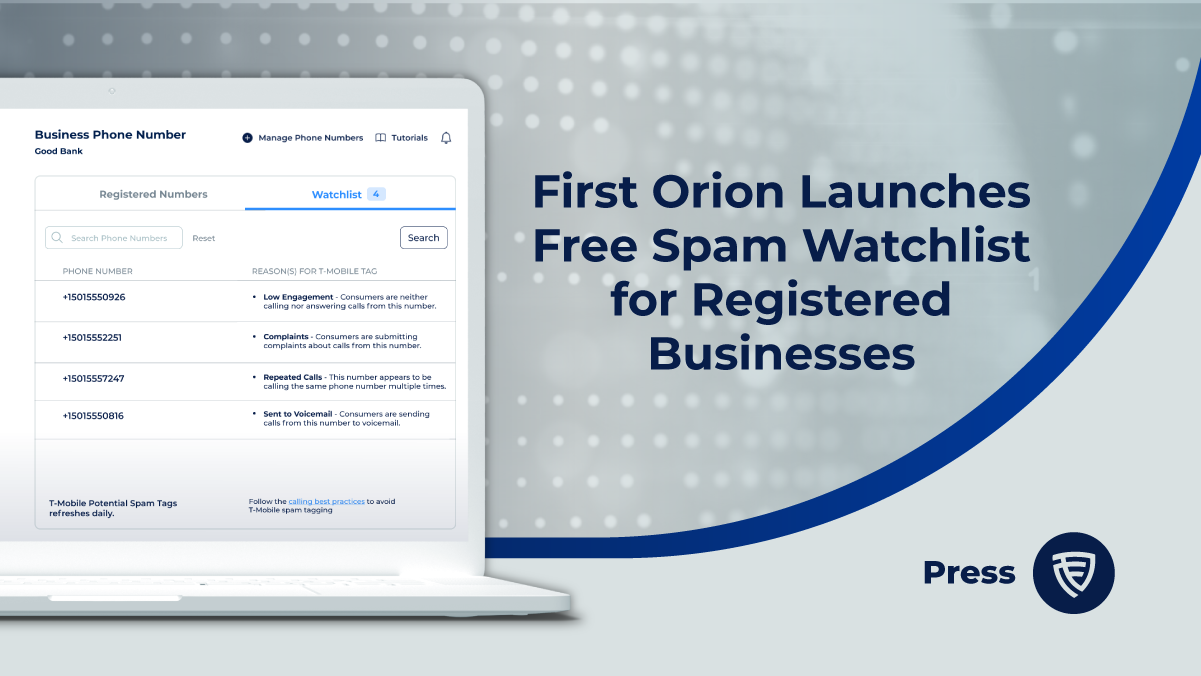
First Orion Launches Free Spam Watchlist
First Orion launched Watchlist within its free Business Number Registration service, letting registered businesses see whether their numbers have been tagged as Potential Spam on the T-Mobile network and view the calling behaviors behind the tag.
Read More
September 30, 2026
First Orion & Vodafone Launch Branded Calling in Ireland
First Orion and Vodafone are expanding INFORM Branded Calling to Ireland, building on launches in the United Kingdom and Germany. Ireland is supported through the same Vodafone CAMARA-based API integration already incorporated into First Orion’s platform, with no additional integration work required.
Read More

September 22, 2026
First Orion Releases 40% Faster with Sauce Labs
First Orion replaced its manual, device-heavy testing infrastructure with Sauce Labs’ programmable Real Device Cloud, accelerating telecom and mobile release cycles by up to 40% while freeing up 35% of engineering and QA capacity.
Read More